Advantages of Using a Forklift Boom
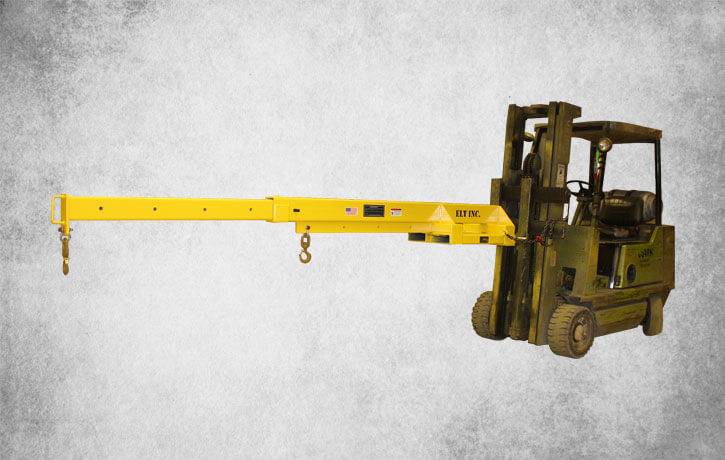
Forklift booms are among the most versatile lifting attachments available today. When properly selected and used, they enable standard forklifts to perform tasks typically reserved for cranes, hoists, or telehandlers. From extended reach to cost savings and improved safety, forklift boom attachments deliver measurable advantages across construction, manufacturing, warehousing, and industrial settings.
What Is a Forklift Boom?
A forklift boom is a lifting attachment that mounts to a forklift’s forks or carriage and extends forward to provide a hook or lifting point for suspended loads. By shifting the lifting point away from the forks, the boom enables the forklift to lift, position, and maneuver loads that are awkward, oversized, or not palletized.
Forklift booms are frequently used to lift machinery, steel assemblies, piping, coils, and fabricated components when forks alone are impractical.
Advantages of Using Forklift Booms
Forklift booms significantly enhance standard forklift capabilities by adding reach, flexibility, and lifting precision. They enable operators to safely handle suspended and non-palletized loads while reducing the need for additional lifting equipment. Below, we’ll explore some of the key advantages of forklift booms and how they improve efficiency, safety, and versatility across a wide range of lifting applications.
-
Extended Reach and Improved Access
One of the most significant advantages of using a forklift boom is its extended reach. Standard forks limit lifting to directly beneath the mast, whereas a boom moves the lifting point forward and outward, allowing access to difficult areas.
This extended reach is particularly valuable in congested or complex work environments where obstacles limit direct access.
Key reach advantages include:
- Lifting loads over machinery, racking, or structural obstructions
- Reaching into confined or recessed work areas
- Positioning loads at higher elevations with greater control
- Reducing the need to reposition the forklift multiple times
By enabling both vertical and horizontal reach, forklift booms help complete lifts more efficiently and with fewer handling steps.
-
Increased Versatility for Non-Palletized Loads
Many industrial loads are not designed to sit on pallets. Forklift booms dramatically increase forklift versatility by enabling the safe lifting of suspended loads using rigging hardware.
This capability enables a single forklift to handle a wider range of materials without requiring additional equipment.
Typical loads handled with forklift booms include:
- Engines, motors, and mechanical assemblies
- Steel beams, pipes, and fabricated structures
- Coils, drums, and cylindrical loads
- Equipment requiring precise placement during installation
For facilities that handle diverse materials, forklift booms eliminate bottlenecks caused by limited fork-only lifting capability.
-
Cost-Effective Alternative to Cranes and Telehandlers
Forklift booms offer a practical and economical alternative to purchasing or renting larger lifting equipment. Rather than investing in cranes or telehandlers for occasional lifting needs, operations can expand the lifting capabilities of existing forklifts.
Cost benefits include:
- Lower upfront investment compared with dedicated lifting machines
- Reduced maintenance and inspection costs
- No additional operator licensing for separate equipment
- Improved return on investment from existing forklifts
For operations with intermittent or moderate lifting requirements, forklift booms deliver strong performance without excessive capital investment.
-
Improved Workflow and Operational Efficiency
By reducing equipment changes and simplifying lift planning, forklift booms significantly improve workflow efficiency. Operators can quickly switch between pallet-handling and suspended-lifting tasks.
Operational efficiency gains include:
- Faster completion of complex lifts
- Reduced downtime waiting for crane availability
- Fewer load transfers and repositioning steps
- Improved utilization of labor and equipment resources
These improvements lead to smoother operations, particularly in fast-paced industrial and construction settings.
-
Enhanced Safety When Used Properly
Forklift booms can improve jobsite safety by reducing manual handling and keeping workers clear of suspended loads. Mechanical lifting minimizes strain injuries and uncontrolled load movement.
That said, safety depends on correct selection, training, and adherence to rated capacities.
Key safety considerations include:
- Understanding reduced load capacity at extended boom lengths
- Maintaining proper forklift stability and balance
- Using approved rigging hardware and lifting methods
- Ensuring operators are trained specifically on boom use
When used correctly, forklift booms deliver controlled, predictable lifting that improves overall workplace safety.
-
Better Use of Limited Space
In facilities with limited floor space, forklift booms offer a major advantage over larger lifting equipment. Forklifts can operate in narrower aisles while still providing extended lifting reach.
Space-saving benefits include:
- Lifting in tight aisles and confined work zones
- Avoiding the footprint of cranes or telehandlers
- Improving access in congested production areas
- Maximizing vertical storage and placement efficiency
This makes forklift booms well-suited for warehouses and manufacturing plants with dense layouts.
-
Adaptability for Specialized Tasks
Forklift booms are available in multiple configurations to meet specialized lifting needs. Telescoping and pivoting designs provide additional flexibility for accurately positioning loads.
Specialized capabilities may include:
- Adjustable reach for varying load distances
- Precise placement without repositioning the forklift
- Compatibility with multiple rigging methods
- Support for installation and maintenance tasks
This adaptability enables forklift booms to support a wide range of applications beyond basic lifting.
Key Considerations When Selecting a Forklift Boom
Choosing the right forklift boom is critical to safe and effective operation.
Important selection factors include:
- Rated capacity at each boom extension
- Forklift compatibility and mounting method
- Intended load types and lifting frequency
- Operator training requirements
- Compliance with applicable safety standards
Evaluating these factors ensures the boom performs as intended without compromising safety.
Forklift Boom vs Other Lifting Equipment
Forklift booms are best suited for operations that require flexibility and mobility without the cost of dedicated lifting equipment.
Forklift booms are ideal when:
- Lifting tasks are intermittent rather than constant
- Space limitations constrain larger equipment
- Budget constraints limit capital purchases
- A single machine must perform multiple roles
They effectively bridge the gap between standard forklifts and specialized lifting equipment.
Forklift boom attachments offer a powerful combination of extended reach, versatility, efficiency, and cost savings. By expanding what a standard forklift can safely accomplish, they enable operations to handle more lifting challenges with fewer resources.
When properly selected, rated, and operated, forklift booms become a valuable asset that enhances productivity while maintaining safety and control across a wide range of lifting applications.